
Specialized Network Engineering Services for ISPs and Municipalities: Design, Configuration, and Support
Practical engineering for networks that need to grow, stay maintainable, and recover predictably.
A network can outgrow its original design long before it outgrows its equipment. A few backhaul links become a regional backbone. Additional subscriber services introduce new routing policies. A municipal fiber network begins carrying public Wi-Fi, government applications, and traffic-system connectivity alongside its original services.
Link Technologies, Inc. provides network engineering support to supplement internal teams, address specialized requirements, and connect hardware selection with implementation. The goal is infrastructure that the operator can understand, document, and maintain—not simply a configuration that passes traffic on installation day.
The Operational Challenge Facing ISPs and Municipal Networks
Growth adds dependencies. An access change may affect a routed uplink, a management VLAN, authentication, monitoring, and customer-facing services. When changes accumulate without a consistent baseline, configuration drift makes troubleshooting slower and upgrades harder to predict.
Short maintenance windows compound the problem. Engineers must determine what is safe to change, how to verify success, and how to recover if a dependency behaves differently than expected. Municipal operators also need to understand which departments and applications share infrastructure, where failure domains overlap, and who approves changes affecting important services.
Useful engineering starts with visibility into those relationships. Accurate topology, configuration records, traffic baselines, and a clear operational owner for each service are as important as protocol selection.
Why Staffing Gaps Matter
Small and mid-sized operators rarely have a dedicated specialist for every area: BGP, OSPF, MPLS, VPLS, VXLAN, network security, Linux servers, and email infrastructure. The same engineer may handle design decisions, customer escalations, field support, and purchasing.
The result can be deferred upgrades, undocumented routing policies, inconsistent equipment staging, or dependence on one person who knows how everything fits together. Outside engineering support can help resolve a particular problem, review a proposed architecture, or turn an undocumented deployment into a repeatable process. It should strengthen the operator's ability to manage the network, with responsibilities and deliverables agreed before work begins.
A Practical Engineering Methodology
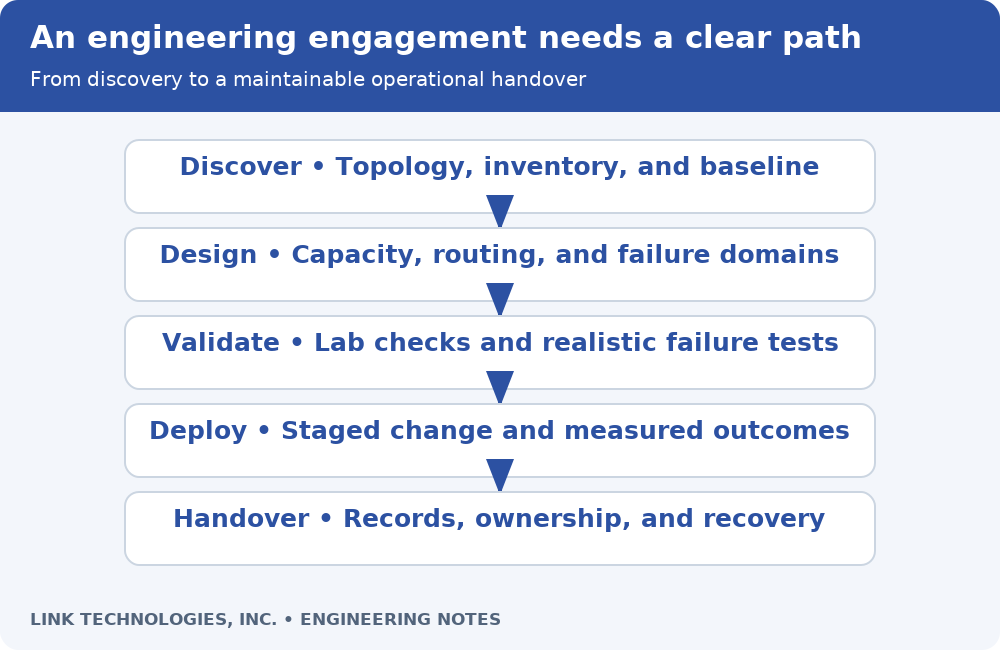
A phased approach makes decisions reviewable and reduces uncertainty before a production change. The depth of each phase depends on the engagement and available information.
- Discovery: Collect topology, device inventory, software versions, traffic profiles, current configurations, and operational constraints. Identify dependencies and gaps in documentation.
- Requirements: Define capacity, redundancy, security, recovery and convergence objectives, maintenance windows, and external dependencies. Separate mandatory requirements from preferences.
- Design: Compare architecture options and document tradeoffs, including equipment capabilities, complexity, operating cost, and future expansion.
- Validation: Where practical and included in scope, test representative configurations, traffic patterns, and failures in a lab or staged environment. Record assumptions that cannot be tested before deployment.
- Deployment and handover: Use staged changes with verification steps and rollback plans. Deliver maintainable documentation and make ownership of follow-up actions clear.
A useful handover explains why decisions were made, not just which commands were entered. That gives the next engineer a starting point when requirements change.
Layer 2 and Layer 3 Design
VLAN segmentation establishes logical separation, but an effective design also defines broadcast-domain boundaries, routed aggregation points, management access, and security policy. Addressing and summarization should support growth without obscuring troubleshooting or introducing unintended reachability.
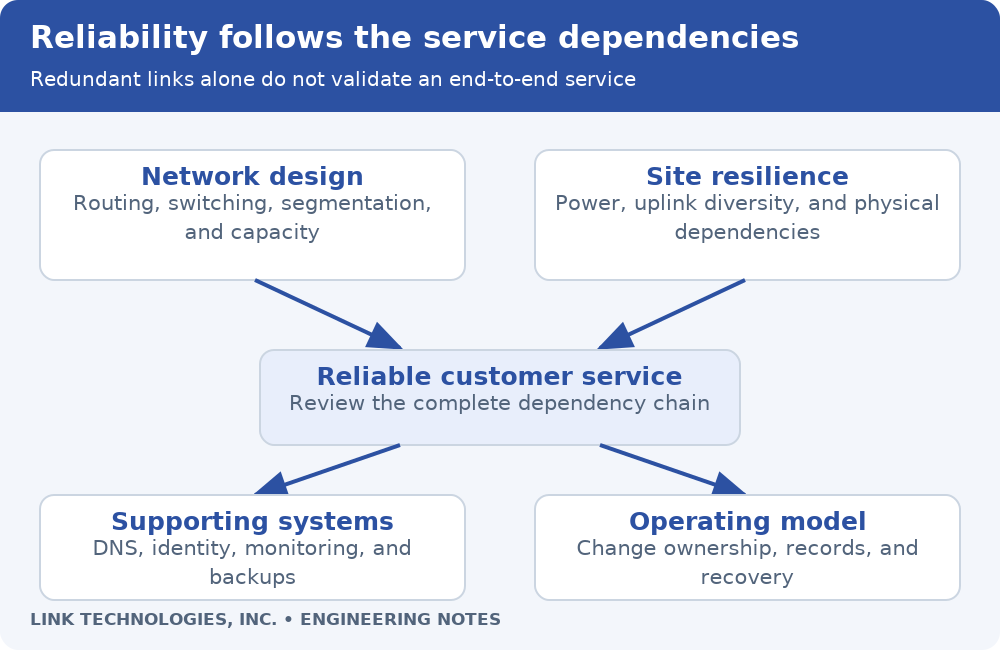
Redundancy needs to be considered end to end: diverse uplinks may still share a power source, conduit, aggregation device, or upstream dependency. Capacity planning should include traffic growth and the load that surviving equipment must carry during a failure.
Interface speed alone does not establish forwarding performance. Hardware offload, firewall processing, and feature support depend on the exact device, software release, and configuration. MikroTik documents platform-specific L3 offload capabilities and limitations; validate the intended feature combination rather than assuming every flow remains in hardware. See MikroTik's L3 hardware-offloading documentation.
Choosing Between MPLS, VPLS, VXLAN, and Routed Services
These technologies solve different problems. The right choice follows the service requirement and the operator's ability to support the resulting network.
- MPLS uses labels for forwarding and can provide a transport foundation for multiple services. MPLS architecture reference.
- VPLS provides multipoint Layer 2 services across a provider network, commonly using MPLS pseudowires. VPLS reference.
- VXLAN carries Layer 2 overlays over an IP underlay. Its encapsulation adds overhead that must fit the end-to-end MTU. RouterOS VXLAN reference.
- Routed Layer 3 services are worth considering whenever applications do not require Layer 2 extension. Avoid extending a broadcast domain simply because a tunnel is available.
Design reviews should address broadcast and unknown-unicast containment, control-plane behavior, failure isolation, and service MTU. Validate both normal operation and failover with representative traffic. A tunnel that works for small packets may still expose an MTU problem under real application load.
BGP and OSPF: Make Routing Policy Explicit
OSPF commonly supports internal reachability, while BGP provides policy-driven route exchange for external peering and other routing designs. Document which prefixes should be accepted and advertised, and where redistribution is permitted. Communities and local preference should express an intentional traffic policy; route reflection should be introduced where the BGP architecture needs it. RouterOS BGP documentation.
Fast recovery is a measured outcome, not a timer setting. Compare failure tests against a baseline, including application impact and the behavior of upstream dependencies. Lowering timers indiscriminately can add instability without improving the service experience. Record what failed, what detected it, when traffic recovered, and whether recovery met the agreed objective.
RouterOS Scripting and Preconfigured Deployments
Repeatable templates can reduce manual differences between sites. A deployment baseline may cover interface naming, VLANs, routing, secure management access, logging, monitoring, and backups. Site-specific values should be clearly separated from the reusable configuration.
Keep templates and scripts in version control, document their intended devices and releases, and test against the RouterOS version actually being deployed. Store credentials separately from reusable templates and restrict access to configuration backups that contain sensitive information.
Preconfigured hardware also needs a staging checklist. Verify physical ports, intended addressing, management reachability, software versions, and the recovery procedure before shipment or field installation. Include a record of exceptions so technicians do not have to discover them during a maintenance window.
Municipal and Government Procurement
Equipment selection should trace back to actual requirements: available rack space, power, environmental conditions, interfaces, security needs, capacity, and replacement lead times. A familiar model is not automatically the right choice for every site.
Link Technologies, Inc. can combine hardware supply with integration planning. Useful procurement and acceptance records include serial numbers, firmware versions, staging results, acceptance criteria, spare-equipment requirements, and replacement procedures. Any required certifications, purchasing eligibility, or contract conditions must be established for the particular procurement; they should never be assumed from a product family or service description.
Linux Servers, Email, and Supporting Services
Routing and switching depend on supporting infrastructure. DNS, DHCP, authentication, monitoring, and email deserve documented ownership, patching plans, access controls, backups, and recovery testing. Redundant network links do not compensate for an untested restore process or a single authentication dependency.
Email reviews should cover SPF, DKIM, DMARC, and TLS alongside DNS accuracy and mail flow. These mechanisms serve different purposes: sender authorization, message signing, domain authentication policy, and transport protection. They complement operational controls; they do not replace patching, account security, or monitoring.
Restore testing should confirm that the team can recover the actual service and its dependencies. A completed backup job is useful evidence, but it is not proof that an application, configuration, or mailbox can be restored within the required recovery window.
MACsec: Evaluate the Exact Link and Platform
MACsec protects Ethernet traffic at the link layer. Evaluate compatibility at both ends, effective MTU, key handling, throughput, and the behavior of intermediate equipment. It is not a substitute for defining management access or application security.
Do not assume automatic key management or hardware encryption is available on every RouterOS device. MikroTik's current documentation describes manual key configuration and limited, product-specific hardware acceleration. Check the current release and device documentation, and test the intended deployment before making a performance or security commitment. RouterOS MACsec documentation.
Turnkey Engineering and Ongoing Support
Hardware sourcing, design, preconfiguration, deployment assistance, documentation, and continuing support can be coordinated as one engagement. The value is continuity between the equipment being purchased, the design being implemented, and the procedures the operations team will use afterward.
Scope, response expectations, upgrade responsibilities, and escalation procedures are defined by the applicable proposal or support agreement. Confirm which activities are included, who authorizes production changes, and how urgent work is handled. This avoids turning general expectations into assumed guarantees.
Preparing for an Engagement
You do not need perfect documentation to start a conversation. The following information helps identify priorities and estimate the work:
- Current topology, device inventory, and known documentation gaps
- RouterOS versions and licensing information
- Traffic patterns, current utilization, and capacity requirements
- Availability, recovery, and maintenance-window objectives
- Security, procurement, and access requirements
Include a short description of the outcome you need: a new design, a migration plan, resolution of an intermittent problem, or a repeatable configuration baseline. Share sensitive configurations and credentials only through an agreed secure process.
Frequently Asked Questions
What types of networks do you design and configure?
Link Technologies, Inc. supports engineering requirements for ISP, WISP, municipal, and business networks. An engagement can address routing, switching, service delivery, security, or supporting infrastructure. The proposed scope should identify the platforms, services, and outcomes involved.
Can you supply hardware as well as engineering?
Yes. Hardware supply can be coordinated with selection, configuration, and integration planning. Availability, equipment suitability, staging work, and delivery arrangements are confirmed for the specific project.
Do you provide ongoing support after deployment?
Continuing support can be included in the applicable proposal or support agreement. Define responsibilities, response expectations, escalation contacts, and upgrade work before relying on ongoing coverage.
Discuss Your Network Engineering Requirements
Whether you are expanding an ISP backbone, planning municipal infrastructure, or improving an existing deployment, Link Technologies, Inc. can help define the next engineering steps. Visit Link Technologies, Inc. to start a conversation about your requirements.
Leave your comment